

Creating Aerospace Products from CNC Machines: Precision Manufacturing for the Aviation Industry
Introduction
The aerospace industry demands some of the highest manufacturing standards in modern engineering. Aircraft structures, engine components, avionics housings, satellite systems, and unmanned aerial vehicles all require exceptional dimensional accuracy, material integrity, and process reliability.
While additive manufacturing continues to gain attention, CNC machining remains the dominant production method for critical aerospace components due to its ability to achieve tight tolerances, excellent surface finishes, and repeatable quality. According to industry reports from the Aerospace Industries Association (AIA), precision machining continues to play a fundamental role in the production of both commercial and defense aerospace systems.
From prototype development to full-scale production, CNC machining enables manufacturers to transform complex engineering designs into flight-ready components capable of operating under extreme mechanical, thermal, and environmental conditions.
This article explores how aerospace products are created using CNC machining, including material selection, design considerations, manufacturing processes, quality assurance requirements, and future trends shaping the aerospace manufacturing sector.
Why CNC Machining Remains Essential in Aerospace Manufacturing
Aircraft and spacecraft components operate in some of the most demanding environments imaginable.
Aerospace parts must withstand:
- Extreme temperature variations
- High vibration loads
- Cyclic fatigue stresses
- Corrosive environments
- High-pressure conditions
- Long operational lifecycles
As a result, aerospace manufacturers require production methods capable of delivering exceptional consistency and precision.
Research published by the National Institute of Standards and Technology (NIST) highlights that advanced machining technologies remain among the most reliable methods for producing high-performance aerospace components due to their dimensional accuracy and material versatility.
Reference:
https://www.nist.gov
CNC machining offers several critical advantages:
- Tolerances as tight as ±0.001 mm
- Superior surface finishes
- High repeatability
- Compatibility with aerospace-grade alloys
- Excellent dimensional stability
- Traceable manufacturing processes
These characteristics make CNC machining indispensable for mission-critical aerospace applications.
Common Aerospace Components Produced by CNC Machining
Modern CNC equipment is capable of producing a wide range of aerospace parts.
Typical applications include:
Structural Components
Structural parts form the framework of aircraft and spacecraft systems.
Examples include:
- Wing brackets
- Bulkheads
- Mounting structures
- Fuselage fittings
- Frame assemblies
These components often require high strength-to-weight ratios and strict dimensional control.
Engine Components
Aircraft engines contain numerous precision-machined parts.
Examples include:
- Turbine housings
- Compressor components
- Bearing supports
- Fuel system parts
- Engine mounts
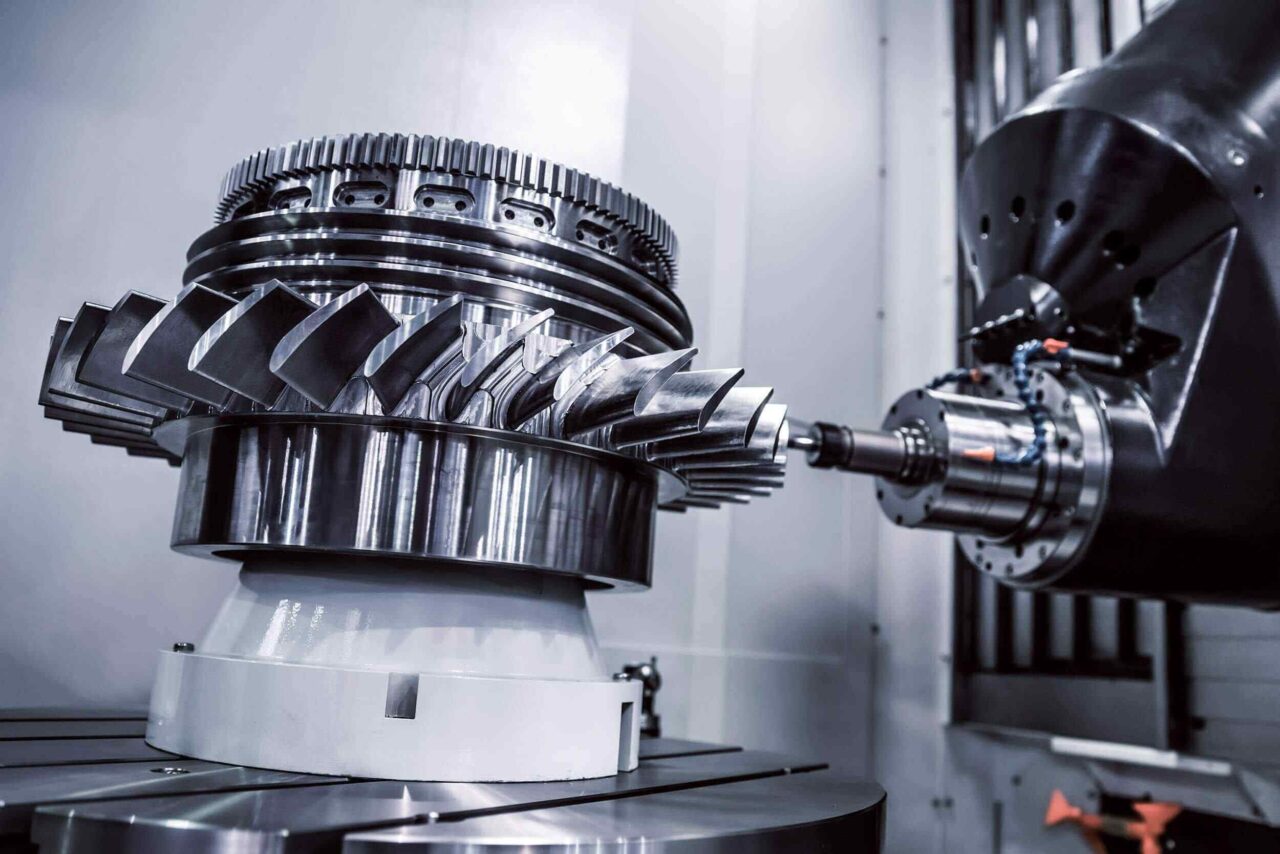
Engine components often require complex five-axis machining operations due to intricate geometries.
Flight Control Components
Precision is particularly critical in flight control systems.
Examples include:
- Actuator housings
- Servo components
- Control linkages
- Hydraulic system components
Even minor dimensional deviations can affect system performance.
Avionics Enclosures
Electronic systems require protective housings capable of withstanding harsh operating environments.
CNC-machined enclosures provide:
- Precise mounting interfaces
- Electromagnetic shielding
- Thermal management
- Structural protection
Satellite and Spacecraft Components
Space applications require lightweight and highly reliable parts.
Examples include:
- Instrument housings
- Antenna structures
- Optical mounts
- Thermal control assemblies
NASA has extensively documented the use of precision machining for spacecraft components due to the strict reliability requirements associated with space missions.
Reference:
https://www.nasa.gov
Aerospace Materials Used in CNC Machining
Material selection is one of the most critical decisions in aerospace manufacturing.
Each material must satisfy specific performance requirements while remaining machinable and economically viable.
Aluminum Alloys
Aluminum remains one of the most widely used aerospace materials.
Common grades include:
- Aluminum 6061
- Aluminum 7075
- Aluminum 2024
Advantages include:
- Lightweight
- Good corrosion resistance
- Excellent machinability
- High strength-to-weight ratio
Aluminum 7075 is frequently used in structural aerospace applications due to its exceptional strength characteristics.
Titanium Alloys
Titanium is widely used in aerospace applications where strength and weight reduction are critical.
The most common grade is:
- Ti-6Al-4V
Benefits include:
- High strength
- Low density
- Excellent corrosion resistance
- High temperature performance
According to Boeing and numerous aerospace material studies, titanium components are extensively utilized in modern aircraft structures and engines.
Reference:
https://www.boeing.com
Stainless Steel
Aerospace manufacturers frequently utilize:
- 303 Stainless Steel
- 304 Stainless Steel
- 316 Stainless Steel
- 17-4 PH Stainless Steel
These materials provide excellent corrosion resistance and mechanical durability.
Nickel-Based Superalloys
High-temperature aerospace applications often require:
- Inconel 718
- Inconel 625
- Hastelloy
These alloys maintain mechanical properties under extreme thermal conditions.
Research from the European Space Agency highlights the importance of nickel-based superalloys for propulsion systems and high-temperature aerospace applications.
Reference:
https://www.esa.int
The CNC Machining Workflow for Aerospace Products
Creating aerospace products involves a highly controlled manufacturing workflow.
Design and Engineering Review
The process begins with detailed CAD models and engineering documentation.
Engineers evaluate:
- Functional requirements
- Load conditions
- Material specifications
- Manufacturing feasibility
- Regulatory requirements
Design for Manufacturability (DFM) reviews help eliminate potential production challenges before machining begins.
CAM Programming
Computer-Aided Manufacturing (CAM) software converts CAD models into machine instructions.
Advanced toolpath strategies are developed to:
- Minimize cycle time
- Improve tool life
- Reduce vibration
- Enhance surface quality
Five-axis machining strategies are commonly employed for aerospace components due to their geometric complexity.
Material Preparation
Raw material certification is critical in aerospace manufacturing.
Material verification typically includes:
- Chemical composition analysis
- Mechanical property verification
- Mill certificates
- Traceability documentation
Material traceability requirements are commonly specified under AS9100 quality standards.
Reference:
https://iaqg.org
Precision Machining
Machining operations may include:
- Milling
- Turning
- Drilling
- Thread milling
- Boring
- Surface finishing
Multi-axis CNC systems enable complex geometries to be produced in a single setup, reducing cumulative positioning errors.
Inspection and Validation
Every aerospace component undergoes rigorous inspection.
Common inspection methods include:
- Coordinate Measuring Machine (CMM)
- Optical scanning
- Surface roughness testing
- Hardness testing
- Non-destructive testing (NDT)
Inspection data is often recorded and archived for full traceability.
Five-Axis CNC Machining in Aerospace Production
Five-axis machining has become a cornerstone of aerospace manufacturing.
Compared with traditional three-axis machining, five-axis systems provide:
- Reduced setup times
- Improved accuracy
- Better surface finishes
- Greater geometric flexibility
Research published in the International Journal of Advanced Manufacturing Technology indicates that five-axis machining significantly improves productivity and accuracy when producing complex aerospace geometries.
Reference:
https://link.springer.com/journal/170
Common five-axis aerospace applications include:
- Impellers
- Turbine blades
- Structural brackets
- Aerospace housings
- Satellite components
The ability to machine multiple surfaces in a single setup is particularly valuable for aerospace production.
Quality Standards and Aerospace Certifications
Quality assurance is non-negotiable in aerospace manufacturing.
The industry operates under strict international standards.
AS9100
AS9100 is the globally recognized aerospace quality management standard.
It incorporates:
- Risk management
- Configuration control
- Product traceability
- Supplier management
- Continuous improvement
Reference:
https://iaqg.org
NADCAP
Special processes often require NADCAP accreditation.
Examples include:
- Heat treatment
- Welding
- Non-destructive testing
- Surface finishing
Reference:
https://www.eauditnet.com
First Article Inspection (FAI)
Aerospace manufacturers frequently perform First Article Inspection according to AS9102 requirements.
FAI verifies that production processes can consistently produce conforming parts before full production begins.
Challenges in Aerospace CNC Machining
Despite its advantages, aerospace machining presents significant challenges.
Difficult-to-Machine Materials
Titanium and Inconel generate high cutting forces and elevated temperatures.
These materials often require:
- Specialized tooling
- Advanced cooling systems
- Optimized cutting parameters
Tight Tolerances
Aerospace components frequently require tolerances below ±0.01 mm.
Maintaining such precision demands:
- Machine calibration
- Thermal compensation
- Advanced inspection systems
Documentation Requirements
Every production step must often be documented.
This includes:
- Material traceability
- Inspection records
- Process validation
- Operator qualifications
Documentation requirements add complexity but are essential for safety-critical applications.
Future Trends in Aerospace CNC Manufacturing
The aerospace industry is rapidly adopting advanced digital technologies.
Emerging trends include:
AI-Assisted Manufacturing
Artificial intelligence is increasingly used for:
- Toolpath optimization
- Predictive maintenance
- Process monitoring
- Quality prediction
Digital Twins
Digital twins enable virtual validation of machining processes before production begins.
Benefits include:
- Reduced development time
- Lower production risks
- Improved process optimization
Hybrid Manufacturing
Manufacturers are increasingly combining:
- Additive manufacturing
- CNC machining
This hybrid approach enables near-net-shape production followed by precision finishing.
Smart Factories
Industry 4.0 technologies are enabling:
- Real-time monitoring
- Automated quality control
- Connected manufacturing systems
- Enhanced traceability
These innovations are expected to further improve efficiency and reliability across aerospace supply chains.
Conclusion
CNC machining remains one of the most important manufacturing technologies in the aerospace industry. From structural aircraft components and turbine housings to satellite systems and avionics enclosures, CNC-machined parts continue to provide the precision, reliability, and material performance required for flight-critical applications.
As aerospace designs become increasingly complex and performance requirements continue to rise, advanced CNC technologies—including five-axis machining, AI-assisted process control, and hybrid manufacturing systems—will play an even greater role in the future of aerospace production.
Manufacturers that combine advanced machining capabilities, aerospace-quality systems, certified processes, and rigorous inspection procedures will be best positioned to support the next generation of commercial aviation, defense systems, space exploration, and unmanned aerospace technologies.
References
National Institute of Standards and Technology (NIST)
https://www.nist.gov
NASA Manufacturing Technologies Program
https://www.nasa.gov
Boeing – Aerospace Materials and Manufacturing
https://www.boeing.com
European Space Agency (ESA)
https://www.esa.int
International Aerospace Quality Group (IAQG)
https://iaqg.org
NADCAP Accreditation Program
https://www.eauditnet.com
International Journal of Advanced Manufacturing Technology
https://link.springer.com/journal/170
Aerospace Industries Association (AIA)
https://www.aia-aerospace.org
